






Speaking is Scary: How to Prepare for the Cambridge A2 Key (KET) Speaking Exam (For Parents + Students)
Speaking is Scary
The Cambridge A2 Key (KET) speaking exam is often the most intimidating part of the KET exam for students.
But it doesn’t have to be.
(Surprisingly the speaking portion of the KET exam ISN'T the most difficult part for students...but that's for another blog!)
Here's What You'll Learn Today
We'll begin by breaking this down into three parts:
Why is it so scary? (A2 Key speaking tips)
How can we reduce the anxiety? (With some A2 Key speaking tips!)
What is on the speaking portion of the KET exam?
Click on the Table of Contents to see all the sections of this article.
Why the Cambridge A2 Key (KET) Speaking Exam Feels Scary
Expectations
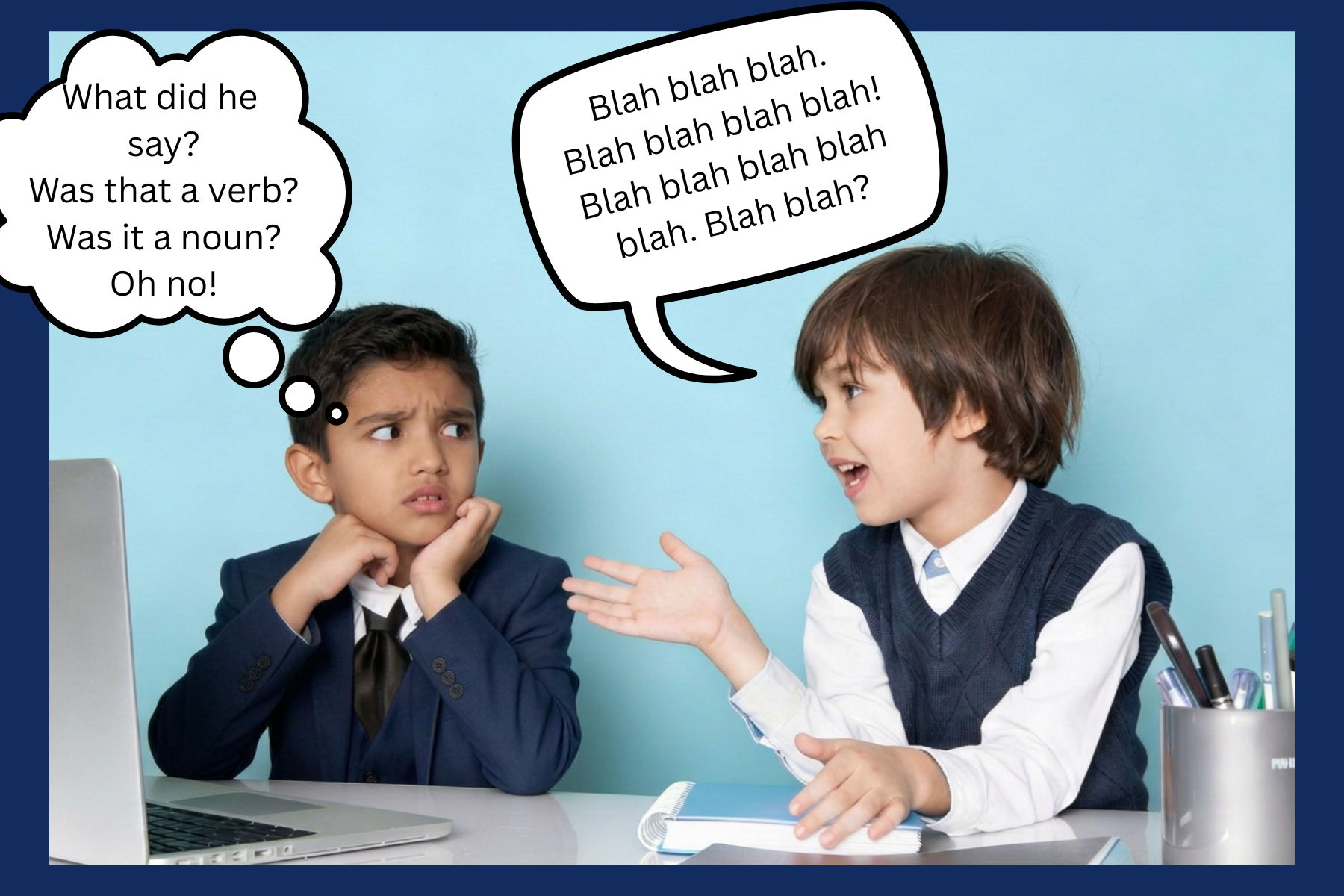
Image of a nervous ESL student listening to another speaker
Can you relate to this?
You've been practicing grammar and vocabulary in class. You understand the rules (mostly), but when it's time to use them, you have to stop and think about it.
Then, a native English speaker walks up to you and excitedly begins to speak in English.
Oh no!
Their accent is different!
They're speaking so fast!
What was that word they said?All of a sudden, you are embarrassed and afraid you'll sound "stupid" to the other person. So instead of trying to speak English, you don't say anything at all.
When many ESL students think of speaking, they often think of all the things that they don't know. At the A2 level, there is still a lot for any ESL student to learn, so there will be a lot of things they don't know.
I've been there.
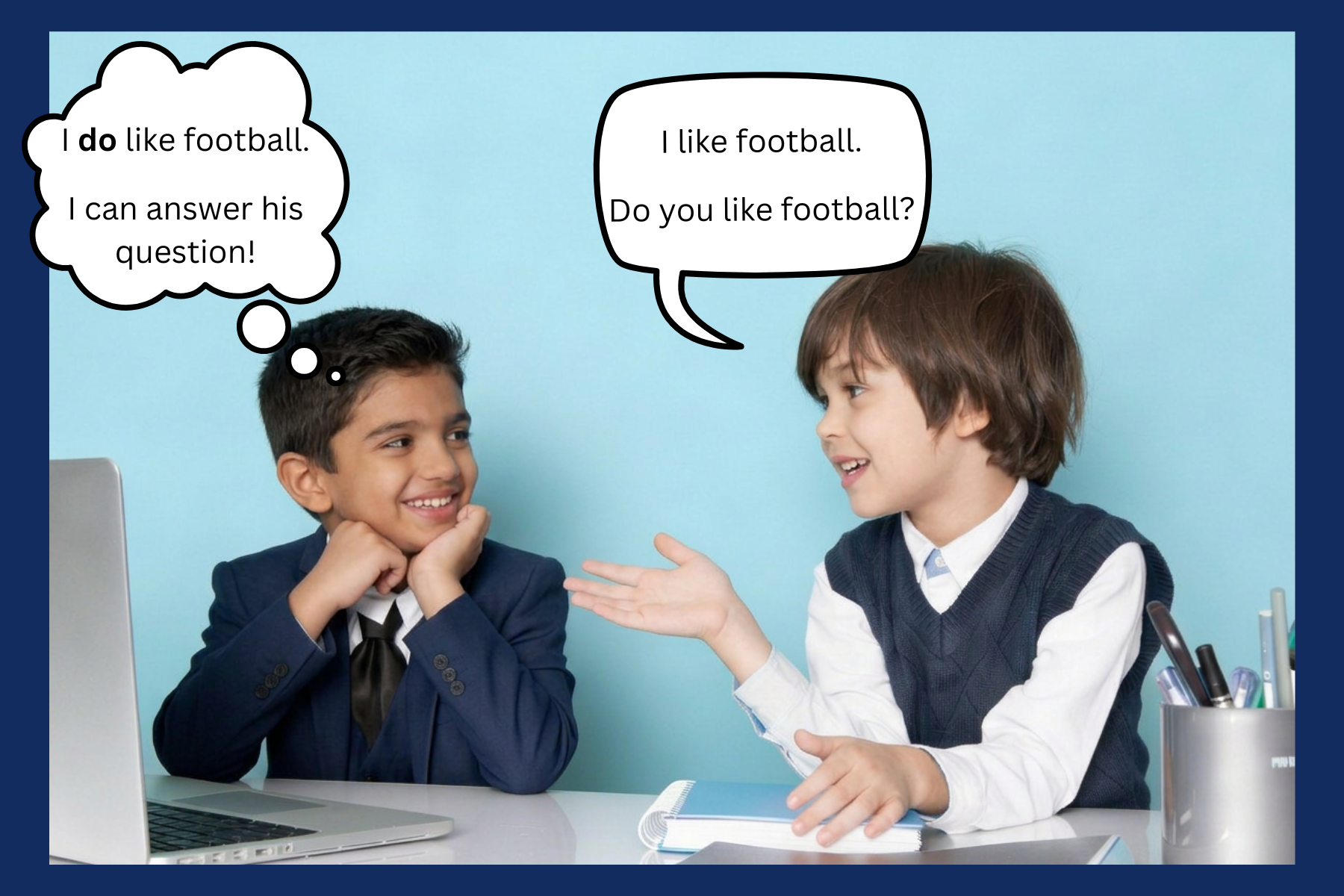
Image of a two ESL students during the Cambridge KET speaking exam
But here's the thing:
On the Cambridge A2 Key (KET) speaking exam, they are going to ask questions at your child's level. The examiners will show images to help each student understand and ask questions, and they will not speak at a fast rate of speed.
The other students will be at the A2 level, too, and they will probably be feeling the same way as your child.
Vocabulary
As a second-language learner, this was something that always made me nervous: What if the other person uses words I don't understand?
During this portion of the exam, Cambridge KET speaking questions typically focus on hobbies, activities, foods, and the like.
And again, examiners will use images as prompts, and they will expect you to know vocabulary only at the A2 level.
"Secret" A2 Key speaking tips
Your child doesn't have to speak perfectly to get a good score.
Mistakes are expected.
Remind them just to do their best and not to worry about errors.
Also, the examiners want the students to succeed on the KET speaking test! They are kind and are not judging your child.

Image of a kind KET examiner helping a student
What to Expect in the KET Speaking Test
KET Exam Format
Knowing the format of the exam can help reduce anxiety. Here is what all students can expect:
There will be 4-5 people in the room: the main examiner, a second examiner, your child and 1-2 other students.
The second examiner will sit in the background and score the students. The main examiner and the 2-3 students will be involved in KET speaking questions and answers.
The A2 Key Speaking test is made up of two parts and is very short. For groups of two students, this portion lasts around eight to 10 minutes; for three students, it will be about 13 to 15 minutes.
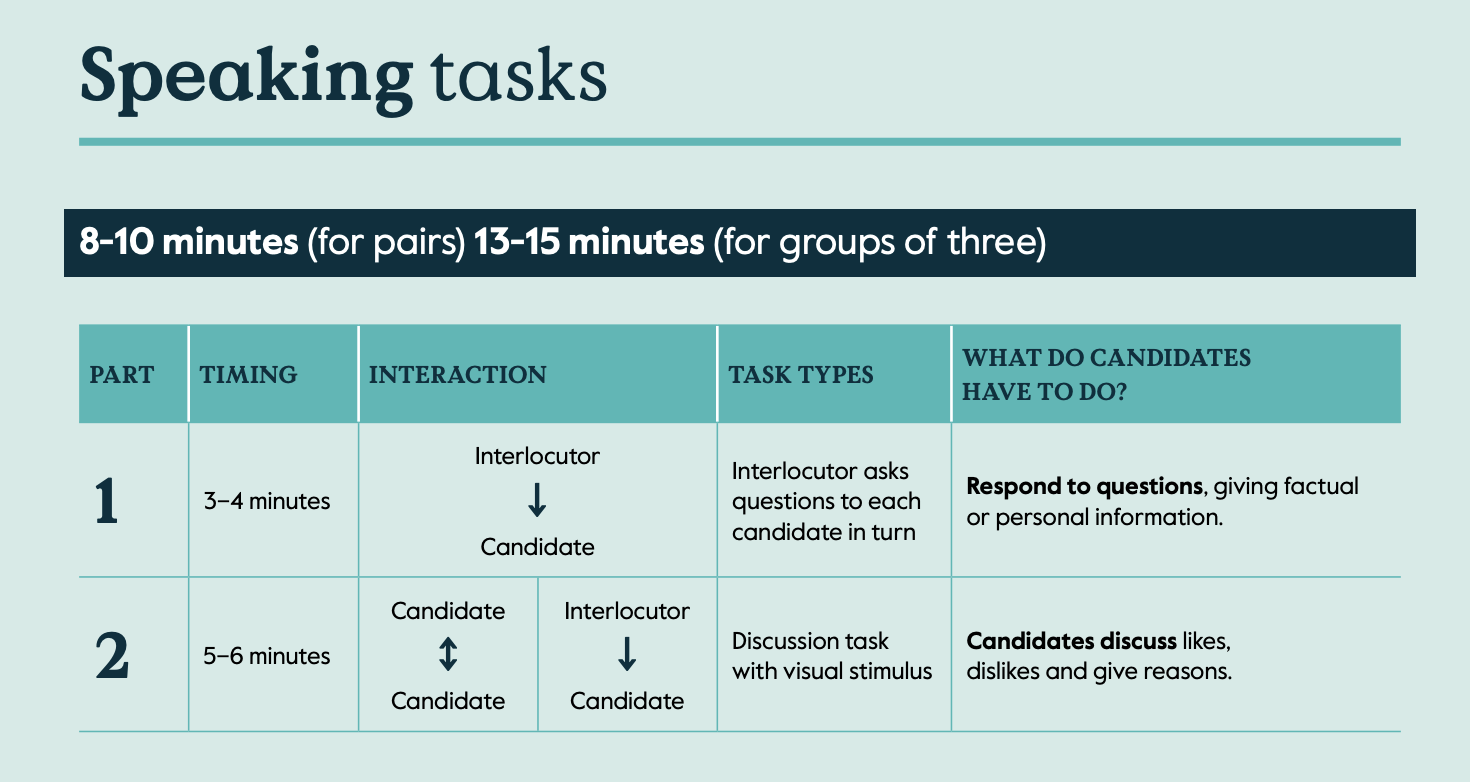
Chart: tasks for the Cambridge A2 Key (KET) speaking exam from Cambridge teacher handbook
Two-part speaking paper
As you can see on the chart above, the speaking paper is broken into two portions.
During the first portion, the examiner ("Interlocutor") will ask each student ("Candidate") a variety of questions, such as, "What is your favorite hobby?" or "Do you like to play basketball?"
During the second portion, the examiner will use pictures as a prompt for the Cambridge KET speaking questions and answers. The examiner will ask students questions, then the students will ask each other questions and respond to each others' questions.
How to Prepare for the KET Speaking Exam (Simple Strategies)
Practice:
Here are a few suggestions to help practice for the speaking portion of the KET speaking test.
Intonation with different punctuation - during practice, help your child use the correct intonation for questions (question marks), to show excitement (exclamation points), and when giving information (periods).
Speak with a partner - this practice is great for both natural, "real life" speaking and for the exam. Show your child images of children playing, eating, and talking to friends. Then ask your child questions about it in English. If your child has a friend learning ESL, the two of them can practice together.
Scripted role play - use these role plays for practice or look online to find role plays appropriate for A2 level students. These show students what the correct formation of sentences is, as well as demonstrating what a short conversation can look like.
These three suggestions come from a blog post on the Cambridge official website called, "Your guide to teaching speaking skills for A2 Key and B1 Preliminary exams".
Watch videos of the actual exam
There are several videos on the web (YouTube) that show real students during an actual KET speaking exam.
During the video, you will see the examiner asking the Cambridge KET speaking questions and the students responding.
In the description box under the video, you'll also be able to find the examiners' comments to learn more about how they score the students.
Share this
Share the information on this blog with your child. As they learn about the exam, it can reduce test anxiety.
It helps to know other students are nervous, too. It also helps to know that the examiners are kind and want the students to succeed.
KET Speaking Top Tip for Students (How to Get a Better Score)
I'm sure that your student has heard her teacher say: "Tell me in a complete sentence." This is a very important piece of advice for real life conversations and on the speaking portion of the KET exam.
On the exam, it is okay to use short answers, but students should speak in complete sentences and attempt to use at least two sentences to answer a question.
For example, if someone says, "Do you like to eat chicken?" the response can be, "No, I don't like to eat chicken. I like to eat vegetables."
What To Do Next
2026 DATES FOR CAMBRIDGE KEY (A2) KET EXAM
9 May 2026 (Saturday)
13 June 2026 (Saturday)
These dates will be here soon! Be sure to confirm your test date with your local center.
Below are available options for preparing for the 2026 Cambridge Key A2 (KET):
CAMBRIDGE KEY (A2) KET EXAM PREP PAGES
The official Cambridge Key (A2) KET exam wegsite is brimming with resources for students and parents preparing for the KET exam.
You'll find sample questions for all parts of the exam, video examples of the speaking portion of the exam, the official vocabulary list, what to expect on exam day, and more.
PARENT PADLET
The Cambridge Key A2 official website has a plethora of information to help prepare for the KET exam. Unfortunately, that can also be overwhelming.
I have created a page of activities, games, and sample test questions - both from the official sites and from other KET exam pages - just for parents. And it's free!
These resources are organized within a site called "Padlet", which creates a digital bulletin board to easily locate just the type of activities you are searching for.
To log on to Padlet for free, just click the button below.
And if you have any questions, you can reach out to me for assistance.
SELF-PACED TOPIC COURSES
If you want to know exactly what to expect on each portion of the exam, self-paced (pre-recorded) classes are available. The courses explain what will be on each exam and give sample Cambridge KET speaking questions to practice (with answer keys for reading, writing, and listening). They also include review games and fun "brain breaks" throughout each lesson.
Each course is in English so that students can practice listening at a comfortable speed. Parents can work and watch alongside their student - to relieve some of the pre-exam anxiety for everyone!
Also included are lesson planners loaded with ideas for English practice.
Check out the list of courses here:
BOOTCAMPS
A live one-week / five-day "bootcamp" is also available. Bootcamps are short, intense classes that can be a great boost any time during your student's preparation for the full exam.
Bootcamps are limited to 2-4 students. This is the perfect size for practicing with other students, while still receiving individual attention.
Students focus on speaking and listening during the bootcamp, with writing included to reinforce skills and support exam performance.
Attention to the exam format will be limited, but parents will have access to sample exams and answers to the exams that you can use at home.
Learn about the bootcamp here:
10-WEEK INTENSIVE COURSE
Are you planning for the KET exam in 2027? If so, the 10-week intense course may be just what you need. It is a live course with small groups (2-4 students).
Sign up for the waitlist here to find out when the next 10-week course begins: